Citizens Advice
Redesigning digital consumer and energy debt advice to improve outcomes for vulnerable users, reduce adviser pressure and unlock £6m of government investment
Overview
My Role: Senior service designer + UX researcher
Client: Citizen’s Advice
Collaborators: Doing Good
Citizens Advice handles 825,000 contacts annually, but an estimated 10 million people attempt to self-serve each year. The gap between those two numbers represents millions of unresolved issues: clients without tailored guidance, onward journeys that broke at every handoff, and no way to capture intelligence from digital interactions to share with enforcement partners. A decade of funding reductions had compounded the problem. Adviser capacity was constrained and the website content, though high volume, was too generic to drive successful resolution
The Challenge
An estimated 10 million people visited the Citizens Advice consumer and energy pages each year attempting to self-serve, but most could not find what they needed. Fragmented journeys and overwhelming content meant clients who could have resolved their issue independently were instead turning to advisers.
For those in energy debt or at risk of disconnection, the consequences of that failure were serious. With a major funding decision from the Department for Business and Trade on the horizon, Citizens Advice needed to test whether a better digital model was possible and build the evidence to back it.
“Clients with consumer and energy issues need clear, personalised and accessible routes to resolution – but our current digital channels are fragmented and cannot provide tailored online support or actionable intelligence in the same way the consumer service does.”
– Citizens Advice
Working with pressure
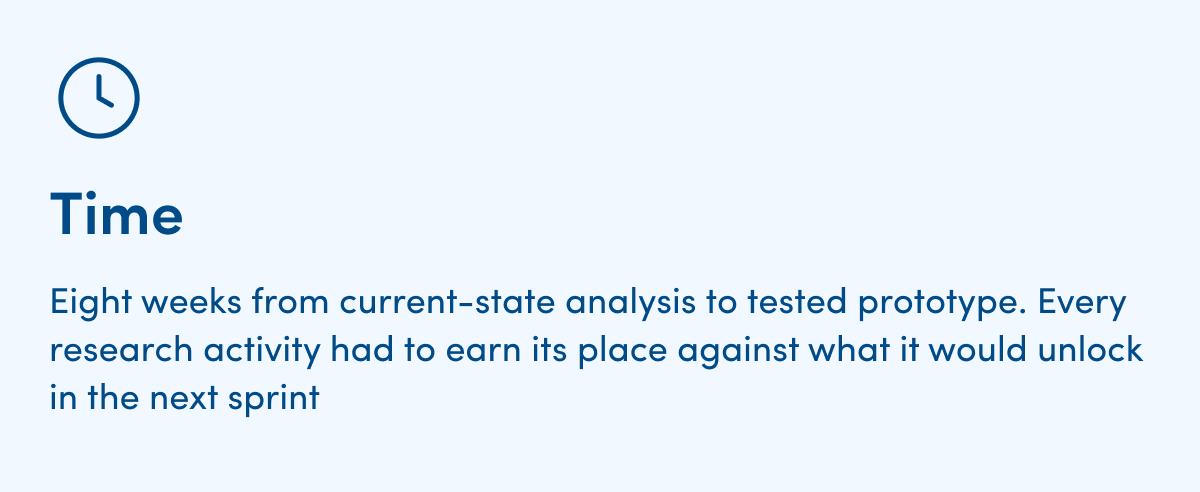
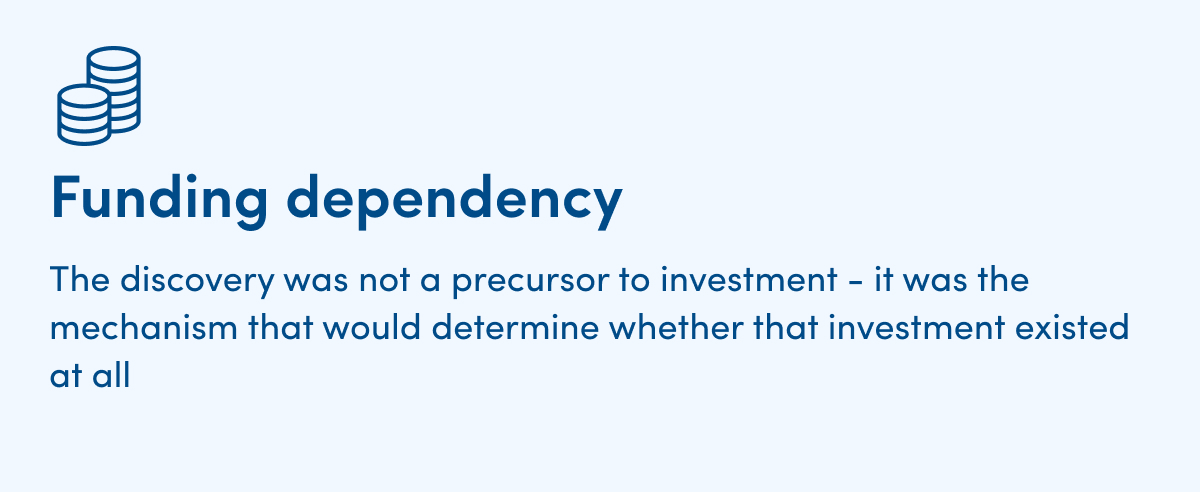
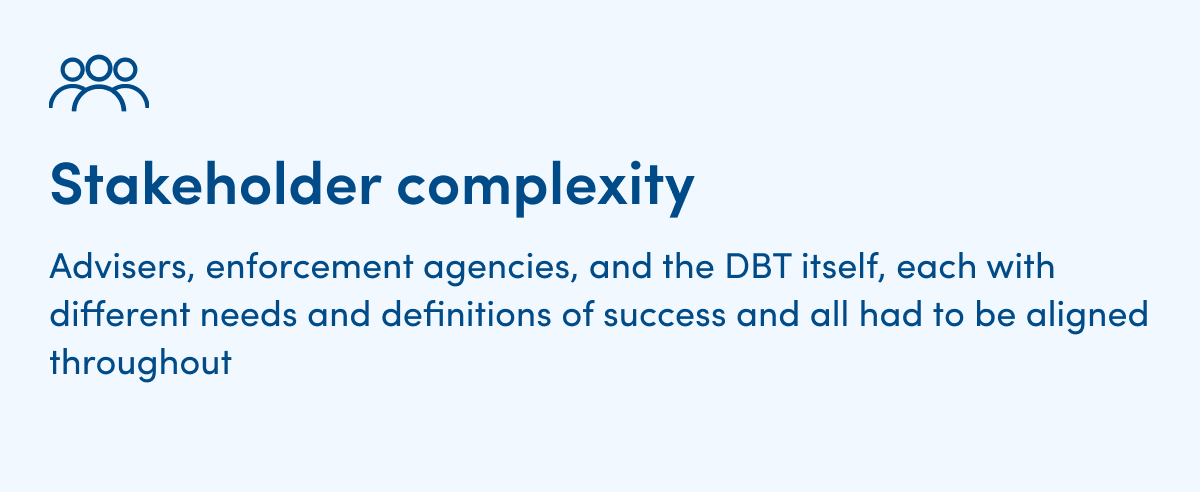
This project had four constraints that could not be solved one at a time: a short timeline, conditional funding, a complex stakeholder landscape, and another team already working on a related tool.
Rather than managing around them, they shaped the approach (a tight timeline is an argument for compression, not a reason to cut corners). That meant being ruthlessly selective with research methods and aligning stakeholders early enough that decisions did not have to be reversed later.
The Approach
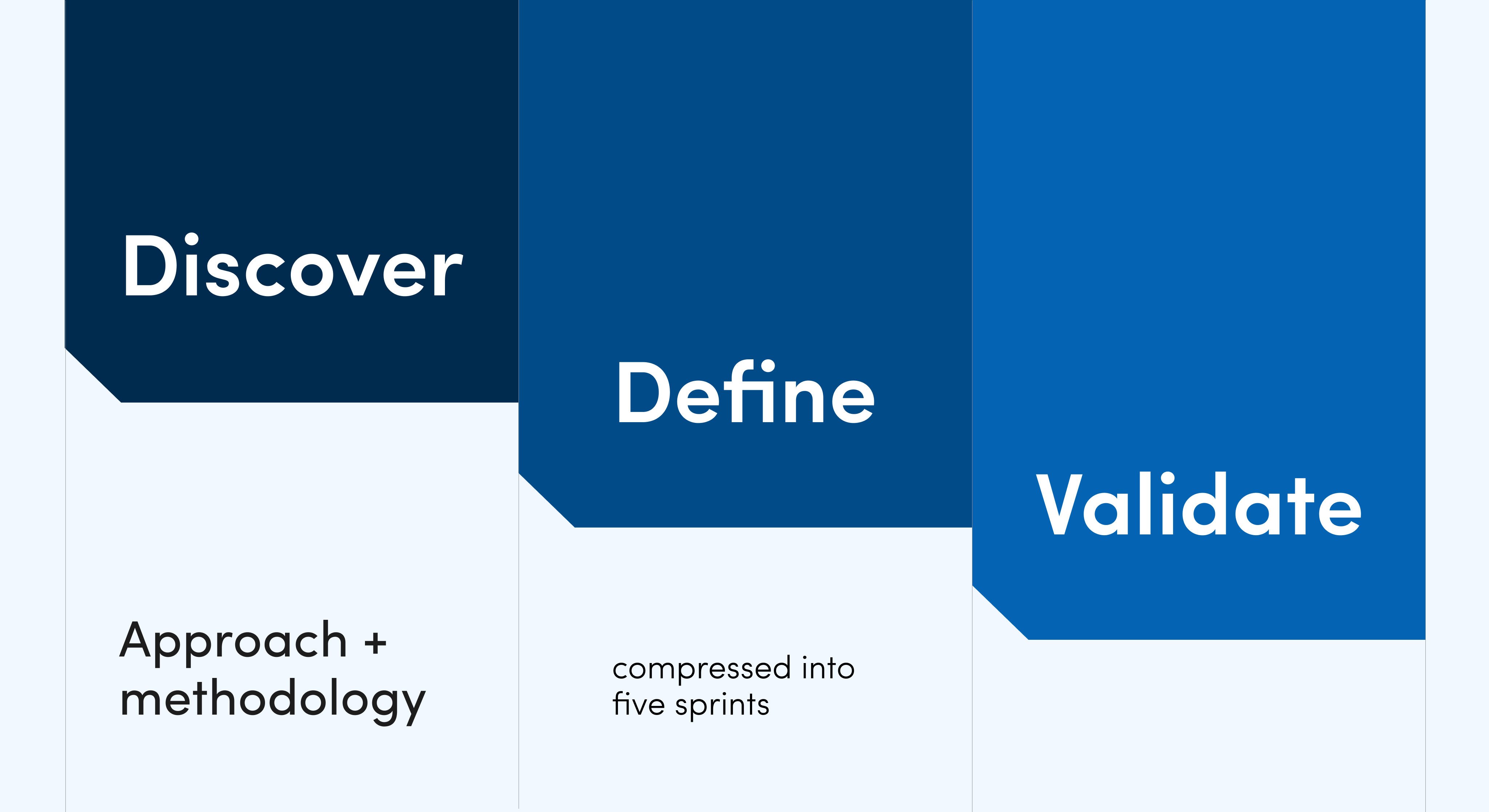
The engagement followed a Discover-Define-Validate structure, aligned to GDS Service Manual discovery principles and adapted for the time-boxed, evidence-generating context. Working in fortnightly sprints generated visible progress from week one and maintained funder confidence throughout.
Co-design methodology
Co-design was a core methodological commitment. Rather than treating advisers and operational staff as interview subjects, I brought them into design sessions as collaborators: surfacing assumptions, mapping pain points in their own words and validating journey concepts before committing resource to prototyping.
Decisions that shaped the work
Given the funding dependency, documentation was compressed and prototyping front-loaded. Producing low-fidelity journey concepts by Sprint 3 meant generating real-world responses from users rather than rather rather than describing concepts that did not yet exist.
Advisers were both a key user group and the people with the most granular understanding of where the current service fails, so rather than treating them as interview subjects, they were brought into design sessions as collaborators.
This surfaced operational constraints early and built internal advocacy for the work. The prototypes were focused on energy debt specifically: the Gas and Electricity Complaints Handling Standard gives Citizens Advice the ability to compel energy companies to participate, and energy debt disproportionately affects vulnerable users, making it the highest-stakes context to design for. Coordinating with the AI consultancy from sprint one ensured both workstreams pointed in the same direction, and the final investment case presented a unified picture to DBT

Deliverables
All planned outputs were delivered within the ten-week timeline, structured to meet both Citizens Advice’s operational needs and DBT’s investment decision requirements.
- Two tested prototypes demonstrating improved client journeys across digital consumer advice, with accompanying analysis of adviser efficiency implications and identified user needs
- User research insights pack covering consumers (including marginalised groups), advisers and ecosystem stakeholders, providing a foundational evidence base for the broader digital transformation work
- Recommended digital advice model tailored to Citizens Advice’s service context, combining research findings, competitive landscape analysis and functional requirements
- Investment case and roadmap structured to directly address DBT’s programme requirements and support the funding decision for the £6m consumer service development fund
- Market landscape analysis, including an assessment of off-the-shelf solutions and an AI opportunity assessment developed in coordination with the existing consultancy
Reflection
The most significant challenge on this project was not the service itself; it was designing the research and delivery process to work within constraints that were non-negotiable. The ten-week timeline, the dual audience of Citizens Advice and DBT, and the need to coordinate across an existing technical workstream all required the same kind of intentional decision-making I would bring to a product.
I came away with a sharper view of when to compress research phases and when compression creates more risk than it saves. In this case, moving fast to low-fidelity prototyping was the right call, but it required unusually tight brief-setting for co-design workshops, so participants were generating input against a concrete concept rather than an open question. It is a discipline I have carried into every time-pressured engagement since – knowing when to open up the problem space, and when to close it down.