Allica Bank
User Behaviour Audit for a UK “startup" bank that provides tailored financial products and lending solutions
Overview
My Role: User Behaviour Analyst
Client: Allica Bank
Allica Bank approached me for user experience support after recognising that their existing site was underperforming, but without a clear understanding of why. I recommended a data-first approach, beginning with a comprehensive user-behaviour audit to uncover the factors affecting conversion, trust, and information flow. This was followed by a content-then-design process to ensure clarity and alignment with user needs, culminating in targeted A/B testing to validate and refine the new experience ahead of a phased rollout.
The impact
The Analysis
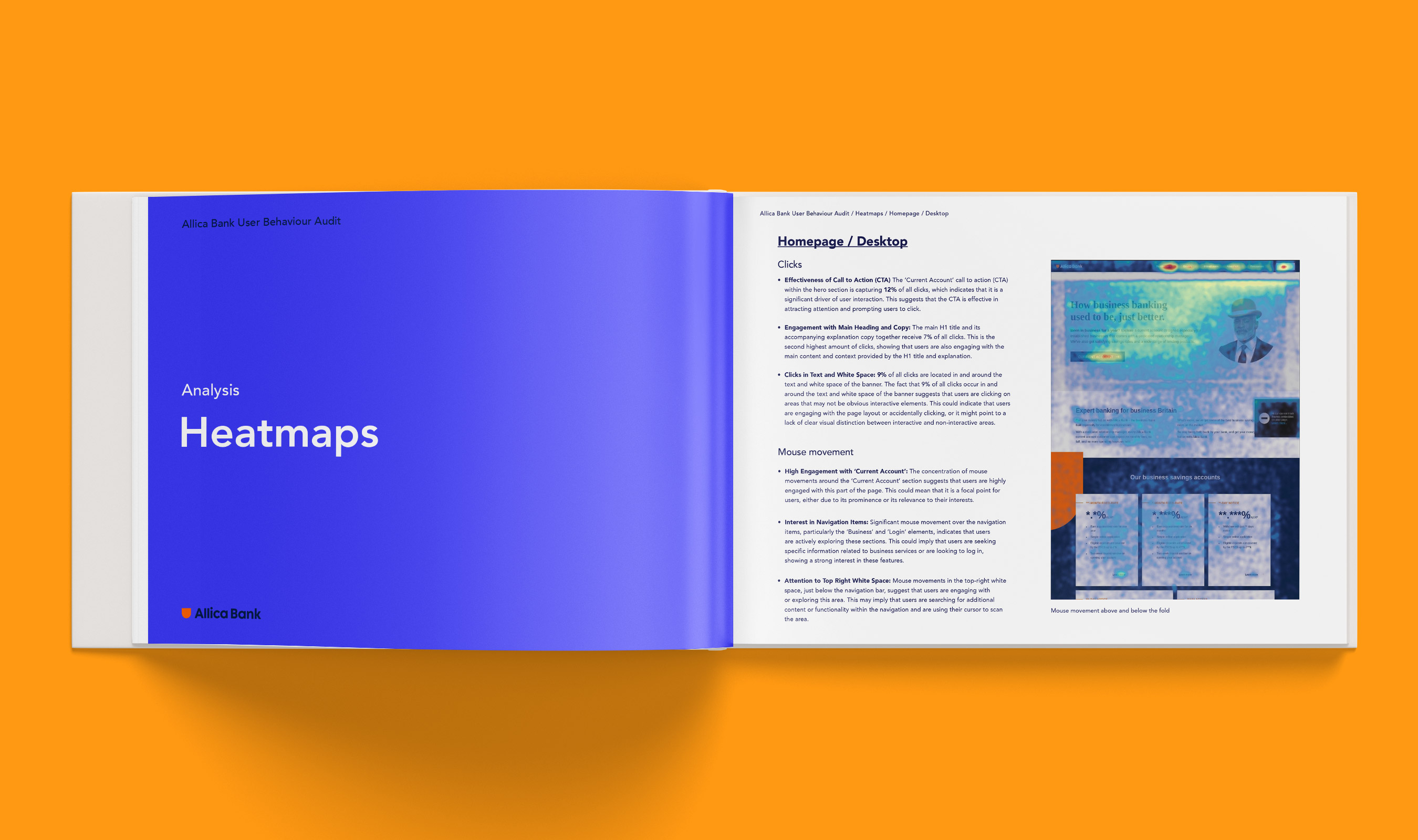
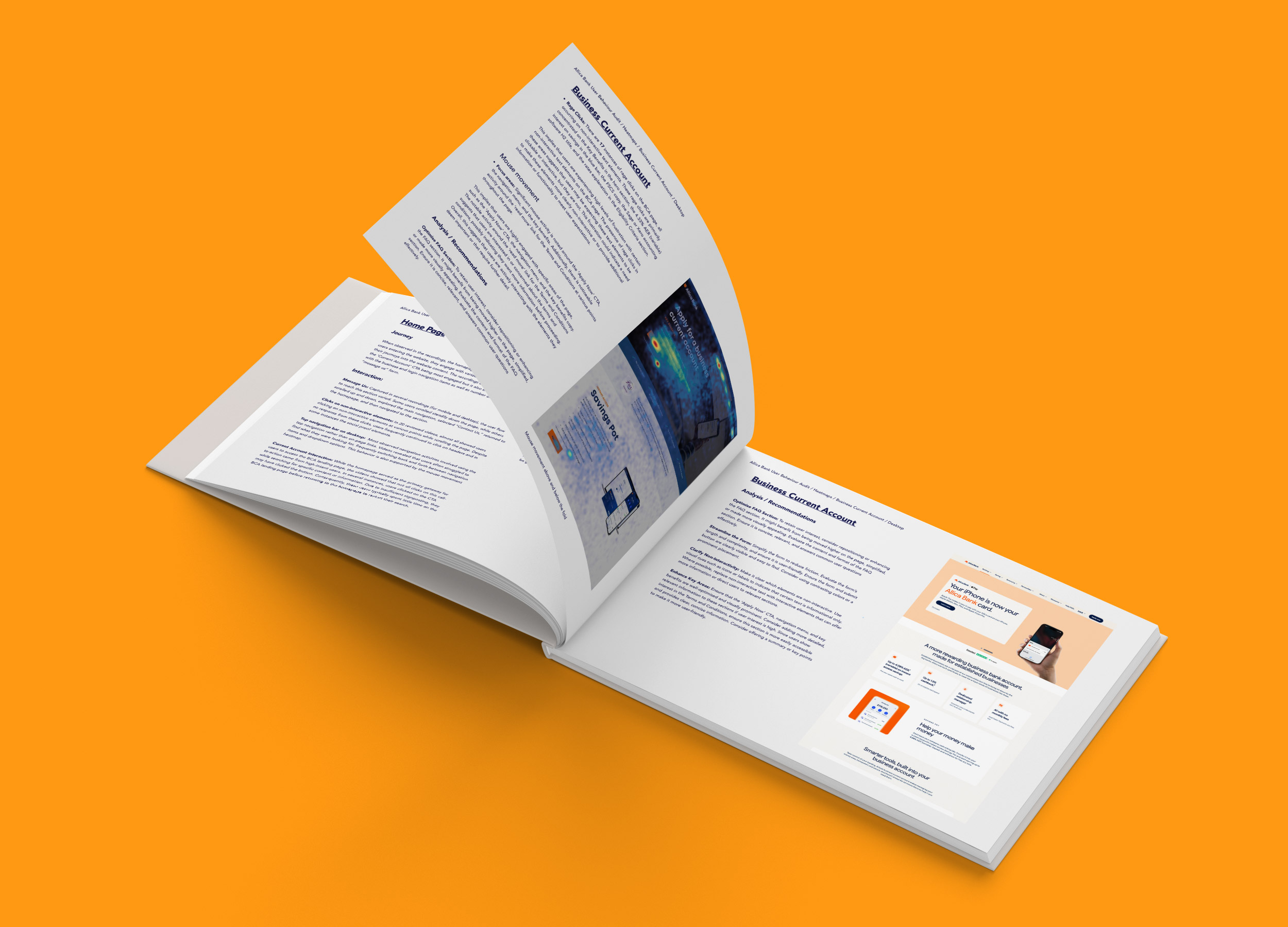
Before any design decisions were made, I conducted a comprehensive User Behaviour Audit (UBA) to uncover exactly how visitors were engaging with the existing Allica Bank website, with a focus on the home page and core product pages. This included:
-
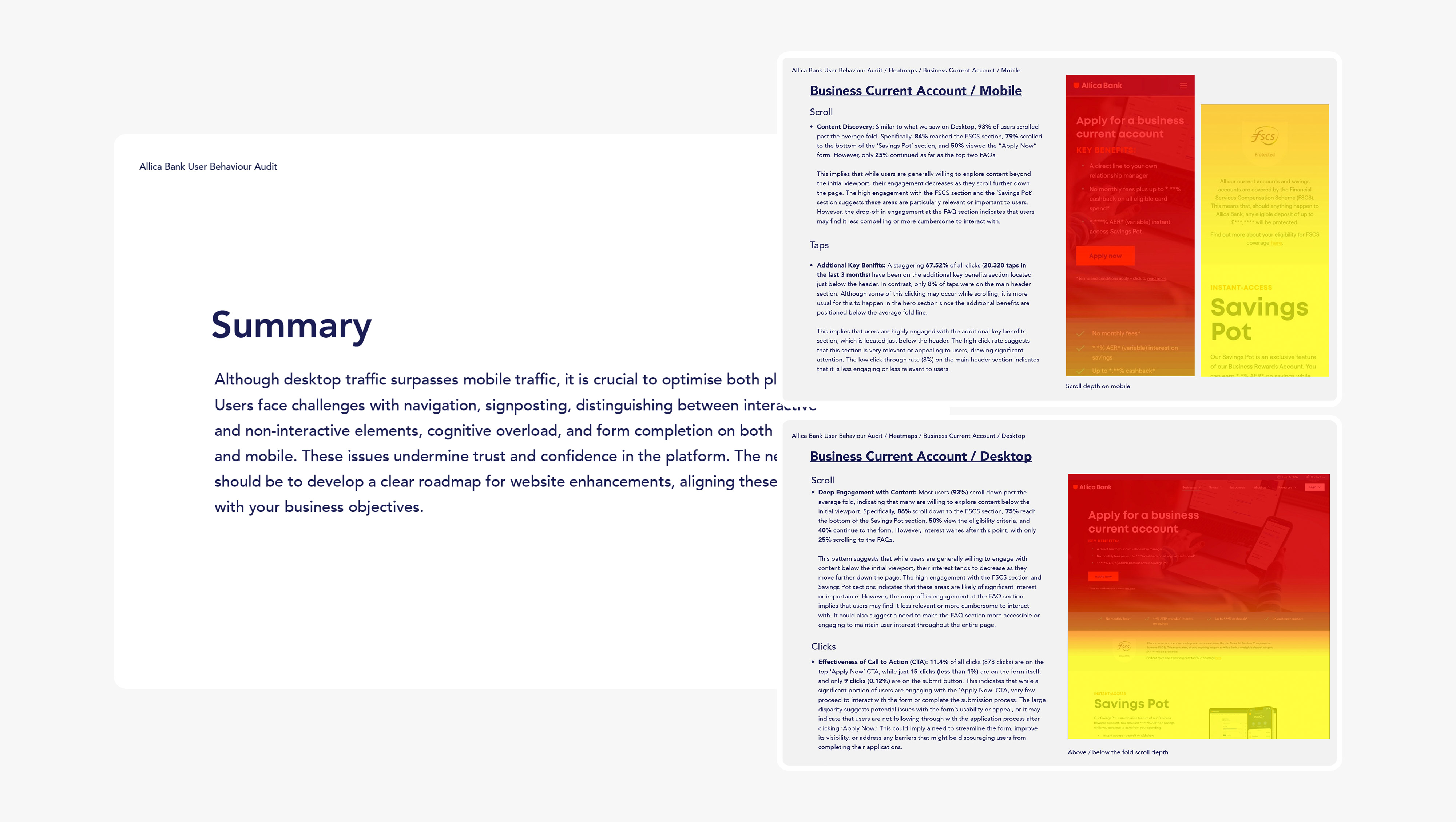
Heatmap analysis (scroll depth, click rate, and mouse movement) across key product and information pages for both desktop and mobile.
-
Review of 100+ recorded user sessions to trace real-world navigation patterns, hesitations, and points of friction throughout the application journey.
-
Data analysis using GA4 and Hotjar to benchmark performance, identify drop-off points, and segment behaviour by device type.
-
Accessibility reviews to surface contrast failures and missing ARIA labels.
The combined insights revealed clear patterns of disengagement: high bounce and exit rates, trust cues positioned below the fold, underperforming CTAs, and mobile usability issues. All of these contributed to a fragmented and low-confidence user experience.
The Challenge
A key challenge lay in balancing the needs of two distinct user groups. Traditional, risk-averse business owners sought the reassurance of an established bank, while younger, entrepreneurial founders were drawn to Allica’s challenger-brand energy. Interpreting behavioural data through these dual lenses deepened my understanding of how trust and innovation could coexist within a single user journey, and how design signals might differently influence each group’s decision to convert.
Another learning edge came from navigating the project’s technical and regulatory constraints. Working within HubSpot’s templating system and a phased rollout plan required every recommendation to be both impactful and feasible. Embedding Consumer Duty and WCAG standards from the outset reinforced that accessibility and transparency aren’t final-phase compliance checks, but central pillars of both accessible design and user trust.
How it adds value
For a “startup bank” like Allica, trust is the currency that converts curiosity into commitment. By surfacing credibility signals, keeping the primary CTA’s visible, and simplifying the journey from discovery to application, the website shifts from a passive brochure to an effective acquisition channel. These changes not only strengthen conversion and SEO performance but also future-proof the platform against regulatory and accessibility risks – building the confidence needed for businesses to choose and stay with Allica.
Why it matters
For any organisation redesigning or optimising a digital product, a User Behaviour Audit (UBA) provides the evidence base that turns uncertainty into clarity. It uncovers how users truly engage with content, highlighting what works, what doesn’t, and why. Embedding this analysis early ensures design decisions are guided by real user behaviour, saving time and driving more meaningful, measurable results.
What they said...
Hannah is a fantastic web designer with a thoughtful approach to UX and accessibility, consistently producing tasteful work. Her research-led explorations have helped us sharpen how we present online and drive lead conversion across key digital touchpoints. She’s reliable, proactive, and a pleasure to work with – always taking feedback on board, delivering on time and going above and beyond. Highly recommended!
Ed Turner
Website Performance Manager